
No English Test for You: Trump’s Campaign Against Iran Now Targets Education
The U.S. government’s economic offensive against Iran is blocking Iranian students and applicants of higher education programs from sitting for tests of English proficiency, further weakening the country’s civil society

Truthout: As U.S. President Donald Trump’s administration tightens its repressive measures against Iran, Iranian students and applicants of English proficiency tests have become the latest targets of a campaign by the White House to severely constrain Iran’s connections with the rest of the world.
With the war on Iran nearing the end of its seventh month, the U.S.-Israeli bombing operations have been supplanted by new tactics, including a package of sweeping sanctions rolled out on August 24, which the Department of the Treasury has labeled as “Economic D-Day,” calling it an “unprecedented, whole-of-government, economic campaign” that will continue until “Tehran stands alone.”
As part of this economic offensive, the Office of Foreign Assets Control has revoked several sanctions regulations licenses, including Iran General License G, which previously allowed academic exchanges and authorized certain educational services in Iran, such as tests of English proficiency that are administered worldwide.
Now, young Iranians seeking educational opportunities overseas are saying their prospects are being undermined: International companies conducting credentialed tests in Iran have ceased their local operations, and third countries where Iranian students could travel to take the tests are also turning them away.
The Test of English as a Foreign Language (TOEFL), Pearson Test of English (PTE), and International English Language Testing System (IELTS) are among the standardized tests that academic institutions in English-speaking and some other countries expect international applicants to pass as a requirement of enrollment in their programs.
Other additional tests are often required by higher education institutions during the admission process, including the Graduate Record Examinations (GRE). For years, these tests have enabled cohorts of young Iranians to follow their educational aspirations in places like the U.K., Canada, and the United States, where they remain some of the largest populations of international students despite stringent visa policies.
This slow but steady trickle of opportunity may now be halted as the U.S. blocks Iranians from satisfying the basic conditions of applying to schools. There are also concerns that overcompliance may add arbitrary prohibitions to the existing rules, worsening discrimination against people of Iranian heritage based on their country of origin or perceived nationality, even if they’re residents of other countries.
“I had one student who had taken the PTE exam in Van and wanted to retake two skill sections, but unfortunately, she was told that because of the new restrictions, she couldn’t participate using an Iranian passport,” said Mona Poorverdi, a 41-year-old English teacher in northern Iran, referring to an applicant she knew who was barred from sitting for the exam in Turkey earlier this summer.
Administered by the London-based Pearson plc, the test includes multiple modules, including PTE Academic, which is accepted by universities in Britain, Australia, and New Zealand. The multinational company, whose chair is the Iranian American businessman and Google’s former Chief Business Officer Omid Kordestani, has now announced that it will comply with the U.S. sanctions and will not schedule or deliver exams for candidates who are residents of Iran.
Shortly after the Treasury’s campaign was set in motion, the New Jersey-headquartered Educational Testing Service (ETS) announced the indefinite suspension of TOEFL and GRE tests in Iran. The private educational assessment organization, which administers a range of language proficiency and certification exams, said the action was “required to comply with U.S. sanctions law.”
Pearson plc and ETS didn’t respond to Truthout’s request for comment.
Other private companies have also joined the U.S. government’s economic warfare targeting everyday life in Iran. Starting September, the Pennsylvania-headquartered educational technology company Duolingo has placed a moratorium on Iranian citizens taking its Duolingo English Test, citing the Trump administration’s sanctions.
Developed in 2016, the online language assessment test is accepted by hundreds of institutions in Anglophone countries, including Yale University, Imperial College London, the University of Toronto, and the University of Sydney. The Duolingo ban also includes Iranians living overseas who apply to take the test using an Iran-issued government ID.
Beyond language evaluation tests, other pathways to educational attainment for Iranians are also being choked off. The Law School Admission Council is no longer allowing Iranian students or students of Iranian heritage — including Iranian Americans and Iranian Canadians — to sit for the law school admission exam, sparking concerns that it has taken the federal restrictions one step further by extending them to Iran-born residents of North America.
These actions harken back to similar practices specifically targeting Iranian Americans under the first Trump administration. In January 2020, a leaked memo showed Customs and Border Protection had instructed its officers to detain Iranian Americans returning to Washington State from Canada and question them about their religion and political views. Some 200 people were reportedly affected within a two-day period.
On August 31, the National Iranian American Council sent a letter to Treasury Secretary Scott Bessent and Secretary of State Marco Rubio, urging them to revise the sanctions policies with consideration for humanitarian and educational exemptions.
“There is no world in which the U.S. preventing young Iranians from taking English proficiency tests leads to the opening of the Strait of Hormuz and yet that appears to be the rationale for this cruel new policy,” Jamal Abdi, president of the National Iranian American Council, said in a statement.
Reza Khanzadeh, professor of Middle East and politics at George Mason University, says the exclusion of Iranian scholars will not only affect Iranians, and will ultimately leave Western scholarship less informed.
“Universities cannot credibly defend academic freedom while remaining passive when an entire class of applicants is denied access to examinations or admissions services because of nationality, residence, or Iranian-issued identity documents,” he told Truthout.
“American universities have historically claimed global leadership by presenting themselves as institutions in which academic ability and intellectual promise transcend national borders,” he added. “If access instead becomes contingent on nationality and shifting foreign policy priorities, competing universities in Canada, Europe, Australia, and Asia may benefit.”
On September 15, Bessent appeared before the House Committee on Financial Services to give an annual testimony on the state of the international financial system. He was pressed by committee member Rep. Sylvia R. Garcia (D-Texas) over the latest stipulations, which she suggested amounted to “another xenophobic policy from this administration aimed at disenfranchising religious minorities and immigrants.”
Bessent cast doubt on the idea that taking the standardized tests would empower Iranians. “We believe freedom for the Iranian people is more important than the SAT,” he said, which Garcia refuted by mentioning a recent call from a constituent who was barred from sitting for the exam because of their national background.
Khanzadeh, who is the author of the 2026 book Generation Denied: The Broken Promise of Education in Iran, believes a population that is collectively targeted will become cynical of foreign governments and is unlikely to interpret external pressure as an expression of solidarity.
“It is not credible to express concern for the Iranian people while pursuing actions that make their children less secure and their futures more precarious,” he said.
Language teachers and learners in Iran, who sustain a sprawling English education ecosystem through dozens of private institutions, are already beginning to echo this sentiment. More families have been enrolling their children in English classes in recent years, either to help them find opportunities to move abroad or simply because they recognize the importance of speaking a second language.
Zohreh Mousavi, a 37-year-old English teacher in Rasht says the decision to prevent Iranian applicants from sitting for the tests of English proficiency is “deeply unjust.”
“In my view, these decisions are simply racist, because you’re supposed to be denied a range of opportunities just because of where you were born without any evaluation of your work,” she told Truthout. “This is a movement backward for countries where at least the media insist they are against racism.”
“If these decisions are made because of politics, they simply exert further pressure on people and have no effect on the governments. Most Iranian immigrants are skilled workers seeking to move to other countries hoping to rescue themselves from the status quo [in Iran],” she added, lamenting that Iranian people’s voices have continuously been ignored.
So far, there has been little pushback in the United States, with a divided Iranian American community failing to take notice of the gravity of these restrictions and human rights organizations prioritizing other issues to highlight. The academic community has also not raised its voice to object to the coercive measures.
This inaction seems to chime with the general failure of universities over the past two years to resist the assault on higher education by the Trump administration and the crackdown on international students. According to the Association of International Educators, international students contributed $43 billion to the U.S. economy in the 2024-2025 academic year, supporting more than 355,000 jobs.
Despite the value they bring to U.S. society, international students were largely left unprotected by their schools as the Trump administration ramped up its immigration enforcement on campuses, revoked 8,000 student visas, and moved to criminalize campus speech after the genocide in Gaza. Prestigious universities reached multimillion-dollar settlements with the federal government and agreed to terms such as the de facto oversight of their curricula.
An Iranian American sociologist believes silence in the face of discrimination will normalize it while weakening the U.S.’s long-term scientific competitiveness.
“Over the past two years, we have already seen what I would describe as a new form of academic McCarthyism, creating fear and self-censorship among professors and students,” said Elham Hoominfar, an assistant professor in the Global Health Studies Program at Northwestern University. “Unfortunately, many academic and human rights institutions, especially those dependent on large donors, may prefer silence rather than confrontation.”
Hoominfar believes that the apparent indifference of the Iranian diaspora to these attacks on civil liberties stems not only from its lack of a unified voice but also from the ways in which its members have absorbed different inequalities over decades.
“I see much of this silence as the internalization of discrimination. It is not only about education; we see similar silence around visa restrictions, family separation, and other policies that treat Iranians as if they have fewer rights than others,” she told Truthout.
“This is harmful not only to Iranian Americans, but to American society as a whole, because discrimination is like a contagious disease — once it becomes normalized against one group, it can eventually spread and affect the entire society,” she added.
Ever since the companies announced their bans, more Iranians have been sharing stories on social media about how they’ve been denied opportunities because of their national origin or received rejections that had nothing to do with their qualifications.
Roozbeh Shirazi, an associate professor of comparative and international education at the University of Minnesota, says the educational sanctions are new weapons that complement multiple rounds of airstrikes on Iran’s educational infrastructure.
“This sends a clear message to ordinary Iranians — notably, any promises of liberation from the U.S. and Israel, and their Iranian diaspora backers, ring hollow when military strikes have destroyed schools, universities, pharmaceutical companies, and other civilian infrastructure,” he told Truthout.
The U.S. government’s campaign against Iran and its intimidation of Iran’s partners have already produced transnational effects. As shared with this author in earlier reporting, certain universities in the U.K., such as the University of Aberdeen and Liverpool John Moores University, have been declining Iranian applicants, citing the applicants’ citizenship. Some Australian universities have also ceased their intake of Iranian graduate students, a move that came shortly after the Australian government banned Iranian tourist visa holders in March.
As the war of aggression against Iran rages on, it appears that ordinary Iranians are being further strangled, whether they live in their home country or as immigrants elsewhere. Unlike in the immediate aftermath of the Russian invasion of Ukraine, no well-known country-specific scholarships have been set up for war-affected Iranians planning to study internationally, and visa regulations have been intensified, not eased.
“Being Iranian or having a connection to Iran should not be an invitation to be discriminated against,” Shirazi said. “There is a collective responsibility to build solidarity and to push back hard on that framing, as well as larger efforts to preemptively criminalize immigrants and international students.”
Related Articles
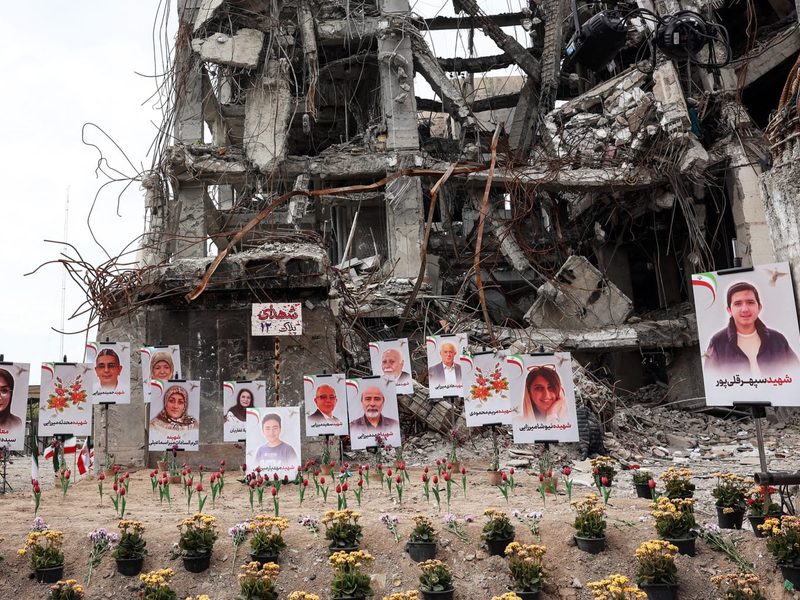
The War on Iran Is Bigger than Gas Prices
Other than the ‘pain at the pump,’ a wedding ceremony turning into a funeral, a sports hall being reduced to rubble, a music academy vanishing under drone attacks, and a young man losing 12 family members in bombings are the real effects of the war on Iran
The EU Abdicated its Moral Responsibility by Failing to Oppose War on Iran
Despite its track record of espousing multilateralism and the rule of law, the European Union refused to denounce the U.S.-Israeli war of aggression against Iran, which legal experts warn violated the UN Charter

Western travelers explore an Iran not shown by the media
A growing number of international travelers are venturing to visit Iran despite the security and economic challenges surrounding the country. After decades of misleading corporate media portrayals, millennial critical thinkers are less willing to accept misrepresentations of Iranians driven by geopolitical rivalries