
Despite the mainstreaming of bigotry, Muslims run in midterm elections
As midterm election races heat up across the United States, more Muslim Americans are venturing to run for office, navigating the odds of success at a time of increasing polarization and political violence characterized by the steep rise of anti-Muslim, anti-immigrant sentiments.

Prism: As midterm election races heat up across the U.S., more Muslim Americans are venturing to run for office, navigating the odds of success at a time of increasing polarization and political violence. Although President Donald Trump’s administration has adopted policies that have unevenly disadvantaged about 4.5 million Americans practicing Islam, the community appears to be galvanized into action as in the aftermath of the 9/11 attacks when suspicion of Muslims spiraled.
Since his return to power in January 2025, Trump’s immigration restrictions, crackdown on civil liberties and foreign policy decisions have haunted American Muslims, as well as other minority groups. His June presidential order banning nationals of 12 countries from entering the U.S. was an updated version of the “Muslim Ban” he rolled out in his first term after he called for a “total and complete shutdown of Muslims entering the United States” as a candidate.
Many visa revocations, student detentions, and academics’ dismissals from universities have been tied to individuals exercising their free speech rights, especially their criticism of the U.S. government’s funding of Israel’s war on Gaza. In this new climate, the administration isn’t the singular actor. A coalition within Congress, known as the Sharia Free America Caucus, founded in December, has enlisted around 40 members at the House of Representatives, routinely promoting prejudiced rhetoric.
The caucus members include Rep. Andy Ogles of Tennessee who has said “Islam is a religion of violence, abuse of women, and ruthless political conquest.” Another member, Rep. Randy Fine of Florida, who has a long history of making derogatory comments about Muslims, wrote on X on Feb. 16, “If they force us to choose, the choice between dogs and Muslims is not a difficult one.”
None of Fine’s statements insulting American Muslims has resulted in official disciplinary action yet, though the Feb. 16 post sparked calls from his colleagues for his resignation and a censure process. Fine appears to have since doubled down on his comments, continuing to post anti-Muslim diatribes on social media.
Amid the government’s normalization of hostility toward one of the three Abrahamic faiths, several Muslims have chosen to enter politics. This year, gubernatorial elections will be held in 39 states and territories, and voters in 435 congressional districts will decide their representatives at the House in addition to 35 Senate seats that will be contested. Despite historically low trends of public representation, several Muslim candidates are on the ballot in the midterm race, including a contender for the governor of Georgia.
Ruwa Romman, a millennial, is a member of the Georgia House of Representatives and the first Muslim woman of Palestinian heritage to be elected to the body. A Democratic Party politician, she will be facing off against a slate of heavyweights in her party’s primary polls for governor on May 19, including the former mayor of Atlanta, Keisha Lance Bottoms.
“Communities have way more power than they have been using over the years,” Romman told Prism in an interview. “My city council member won his race by four votes in a run-off election. …Oftentimes politics can seem so awful, but at the end of the day, it’s a numbers game.”
Georgia’s last Democratic governor stepped down in 2003, and the state has been run by Republican governors ever since. Still, Romman believes her chances are realistic despite pressure campaigns and social media trolling that have been underway, mostly attacking her background and not her ideas.
“They don’t have anything to attack us on. At the end of the day, we tend to run on popular policies, and many of us tend to be progressive,” she said of Muslim politicians and those representing other marginalized communities.
Romman worked previously as the communications director for the Council on American-Islamic Relations’ Georgia branch. “We monitored these threats and this kind of messaging, and it’s an industry,” she said. “There are people who make their money off spreading lies about the Muslim community.”
The state representative also believes that Georgians have appreciated her openness in opposing the war in Gaza as a Palestinian-American.
“I think that so much of the support we are seeing and the reason we are able to build this multi-faith, multiracial, multigenerational coalition is because I am the only candidate in this race that has very honestly and clearly spoken about what is happening in Gaza and named it a genocide,” Romman said.
“Polling will not show this as a number one issue, but what polling will show you is that this is becoming an issue that people will use to determine whether or not you are sold out to special interests, and if you care more about them than corporations,” she said.
In other states, Muslim candidates have been actively campaigning for Congress, expecting neck-and-neck competitions in the primaries. Unlike their opponents, they must divide their attention between raising funds, canvassing, and dealing with online vitriol that sporadically translates into violence in real life, something that has been streamlined with the new political discourse introduced after January 20, 2025.
Minority politicians’ embrace of the midterm elections comes after Zohran Mamdani was elected as the mayor of New York City, making history as the first immigrant and Muslim top city leader in charge of the nation’s financial capital.
In the leadup to the New York City mayoral election, Mamdani was on the receiving end of death threats, cyberbullying, and abusive commentary targeting his identity. The Washington-based Center for the Study of Organized Hate documented 35,522 Islamophobic social media posts on X between June 24, when Mamdani won the Democratic primary, and Oct. 31, one week before election day. In a large portion of the posts, the dehumanizing rhetoric included conspiracies that a Muslim takeover of America was imminent and that Mamdani was plotting another 9/11.
Candidates running for Congress are facing similar abuse. Bushra Amiwala is running for the House of Representatives from Illinois’s 9th Congressional District. She has served on Skokie Board of Education in Cook County, Illinois, and her campaign is gaining traction in a locality that has never sent a Muslim lawmaker to the House. Former Congresswoman Marie Newman has endorsed her.
But Amiwala’s social media feeds are flooded with messages targeting her identity.
“They are viciously personal attacks, and they are intentionally done to distract voters and people from the content of what I am actually saying,” said Amiwala, whose campaign has emphasized economic justice, health care, access to public education, and protection of civil liberties.
She cited the example of her “know your rights” videos posted online last May to educate her constituents about possible encounters with ICE agents, under which she said some people commented, “go back to your country.”
Ironically, Amiwala said, she was born and raised in the district and has lived there her entire life.
“I have never seen local media or any of my fellow candidates acknowledge the amount of vitriol and Islamophobia I receive in the comments section of posts, but at the same time, I don’t know if I expect them to, either,” Amiwala said.
The current religious composition of Congress shows notable diversity. Still, the number of Muslim lawmakers doesn’t mirror their demographic status. According to Pew Research Center, the two chambers of Congress include 461 Christian lawmakers, of whom 55.5% are Protestant and 28.2% are Catholic. There are 32 Jewish, four Hindu, four Muslim, and three Buddhist lawmakers in Congress.
“The limited representation of American Muslims in U.S. politics is not accidental; it reflects a broader system of Islamophobia, xenophobia, and structural barriers that have historically restricted Muslims’ access to political power,” psychology professor Nadia Ansary told Prism in a written response. Ansary is the chair of the department of psychology at Rider University in New Jersey and has studied bullying prevention and discrimination against Muslim Americans.
Policies such as the PATRIOT Act, a post-9/11 statute that exponentially expanded state surveillance and its leeway to pinpoint what counts as terrorism, as well as the anti-Muslim travel bans “reinforce the idea that Muslim identity is inherently dangerous and un-American,” Ansary said.
“This suggests that while American Muslims may be citizens, they are perceived as perpetual foreigners and an inherent threat to national security,” she added.
The Mapping Islamophobia project was an online initiative by researchers at Grinnell College in Iowa who documented instances of anti-Muslim bias between 2001-2021. One segment of the database was Muslim American political candidates, tracking trends in Muslim politicians running for office at different levels between 2012-2020. Destiny Magnett, now the programs and outreach manager at Churches for Middle East Peace, was in charge of the database of candidates.
“In America, Islamophobia is deeply tied to issues of racialization and white supremacy,” Magnett told Prism via email. “One way this is illustrated is the fact that Islamophobic incidents impact people who are not practicing Muslims, simply because they are perceived as such.
“If we are to counter discrimination and abuse of Muslim politicians and public figures, it is crucial that these activities are called out, exposed, and condemned as such,” she added.
Many Muslim Americans in the swing states who threw their weight behind Trump in the 2024 elections and linked their decision to former President Joe Biden’s Middle East policy, expressed their regret shortly after the 47th president was inaugurated and unleashed a barrage of policies targeting their communities. Meanwhile, the perceived threat from the White House’s mainstreaming of intolerance has prompted a national reckoning.
As the elections approach, it is likely that the expressions of hatred will become more explicit, particularly as anti-immigrant rhetoric and crackdowns from the Trump administration also escalate. But the scope of the attacks has been much broader than against immigrants.
Liban Mohamed, 27, was born in Logan, Utah, and raised in nearby Ogden City. On Jan. 5, he announced his bid for the House of Representatives through a video posted to X. While many users were curious, a barrage of spiteful messages overwhelmed Mohamed’s social media.
“The flood of racist and religious hate directed at Liban Mohamed is disgusting,” the Utah Democratic Party said in a statement, clarifying that it wasn’t taking a position on the 1st Congressional District primary race. Ben McAdams, the former mayor of Salt Lake City, who is also running for the same seat, denounced the “hateful and dehumanizing” attacks against Mohamed.
“My identity is a part of my story, just as every Utahn has a story rooted in hard work and community,” Mohamed told Prism in an email. “I believe the people of this district are looking for leadership that reflects their values of service and compassion, and I am confident that our platform’s focus on ‘People First’ is exactly what resonates with them.”
Related Articles

The U.S.-Israeli war on mental health in Iran
After decades of undemocratic governance, economic sanctions, and information warfare by external actors, the US-Israeli war of aggression has increased the risk of mental health issues among Iranians and the intergenerational transmission of trauma
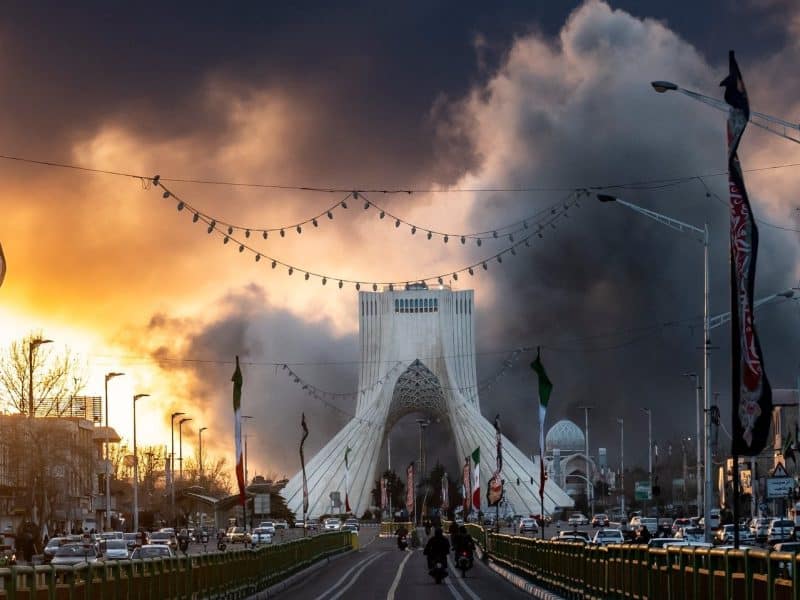
“Nuance, accuracy and reason are often lost”: What the media gets wrong about Iran
Having lived in Iran and later covered it from elsewhere, including Britain and now the US, I have seen how reliance on clichés and stale terminology affects the way some mainstream outlets cover the country. You can read commentary today and, if you removed the date, it could easily have been written 10 or 15 years ago.

Iranians Grapple With Grief While Observing Their New Year During War
Generations of Iranians have cherished their ancient New Year festival Nowruz, shielding it from attempts by some domestic rulers and foreign conquerors to erase it. This year, millions of Iranians marked the advent of spring under the shadow of US-Israeli bombs hitting their neighborhoods, businesses and cultural sites