
Iran’s Protest Movement and Diaspora Politics
Three weeks of protests in Iran over the collapse of the national currency has left the country reeling from hundreds of deaths, violence, destruction, and increasing polarization. In response, Iran’s diaspora has exuded division and confusion.

New Lines Magazine: “Enough is enough.” Despair and exhaustion coursed through the voice of Narges, an English teacher in a small town in the west of Guilan province, as she was leaving me recorded messages on Instagram. She was one of the only four people in Iran who received and could reply to my notes in the middle of a crippling internet shutdown, which the government introduced on Jan. 8 to extinguish the flames of an epic uprising.
The 35-year-old had participated in anti-government protests that started on Dec. 28 and was in constant communication with friends who were also joining the movement in other cities. A physician friend of hers in Rasht told her that in only one day, nearly 30 dead bodies were brought into the hospital where they worked.
As disillusionment starts to set in following a deadly crackdown that stamped out the uprising, everyone is feeling “unhappy, dissatisfied and angry,” she told me, which is why people are not revolting. It wasn’t only brute force that was deployed to silence the protesters. The internet blackout was a tormenting way of confining people to darkness.
“I have been so deeply disturbed by the lack of internet connectivity that I was thinking to myself a few days ago, if the access wasn’t restored, I’d be leaving everything behind, my belongings, my house and my husband, go and stay somewhere like Armenia for at least a month, so that I could continue working — so that I wouldn’t lose my job,” she said.
Narges works with nonprofits overseas as a freelance online tutor, and some of her English language students in Latin America had remained in limbo for the duration of the connectivity disruptions. After a few days, she wondered if they were still expecting her, or if a new teacher had taken her position.
But professional anxiety was only one offshoot of an extended period of digital oblivion. “I’d reach for my phone at least 100 times a day to check the weather forecast, to find an answer to that history question, to look for a new food recipe, only to remember each time that the signals were off. It was like being relegated to the Middle Ages,” she said as her voice surged with intensity. “I was running mad.”
As of this writing, a partial shutdown is in place according to NetBlocks, a cybersecurity watchdog organization that monitors internet freedom from London. No active protests are currently going on.
It all started with an economic freefall that had been long in the making. A U.S. dollar trading at 1.4 million rials wasn’t something that Iranians had ever seen or could fathom. And the collapse of the national currency only served as the overspicing of a dish that was already unpalatable.
Corruption, illiberalism and coercion have long raised a wall of mistrust between Iranians and the state. They have, however, sometimes managed to have their voices heard. Indeed, the Iran of 2026 is not the same as the Iran of 1979 — people have been constantly pushing the boundaries of what the Islamic Republic withholds from them, making gains without external support or favor.
But with pent-up frustrations bursting into the open in late December, the Iranian government was presented with yet another referendum over its legitimacy and statecraft. Yet the “thousands of people” killed, in the words of the country’s supreme leader, the businesses, clinics, bookstores, banks and houses of worship reduced to rubble, and a nation afflicted by fear are all tokens of a failure on that score.
The real death toll of the past weeks of street demonstrations and clashes involving a myriad of state and nonstate actors may never be disclosed. Without direct access or representation inside Iran, international media have mostly been relying on the statistics released by the Washington-based Human Rights Activists in Iran (HRNA), a nonprofit that documents violations of human rights in the country.
As of the evening of Jan. 18, the group has reported a death toll of 3,919, which includes 25 children and youths under 18, and 178 police officers and security forces. There is no indication that the Iranian government will be providing its own figures, even though a senior lawmaker has said the parliament is finalizing its work to release the numbers. Iran’s Ministry of Health spokesperson hasn’t responded to my request asking for clarification on the official tally of casualties.
On the two sides of this complex equation are the theocracy helmed by the 87-year-old Ayatollah Ali Khamenei and the Iranian people, 60% of whom are below the age of 39 according to the United Nations. The members of the patriarchal household cannot hide their arguments in public anymore. They have hit a standstill and don’t appear to have a common language to talk to each other.
Even before the recent protests erupted, the nation’s clerical leader would often frame the people of Iran as being members of two distinct categories. The true test of citizenship could only be passed by those he called the “ummah of hezbollah,” or the nation of the party of God, a metaphorical reference to the most pious, conservative loyalists of the revolution. They are, after all, a visible part of Iranian society.
But Khamenei usually described the other group using a melange of condescending terms: “misguided youths,” “the uncaring rich,” “Westoxified” and “the infantry of the enemy.” Empirically speaking, this group is the largest, most heterogeneous portion of the population, namely the middle class. When they don’t go to the ballot box, election results end up being embarrassing.
In Tehran, the country’s capital and one of its most progressive cities, the turnout in the parliamentary election runoff in May 2024 stood at a paltry 8%, a rare event since the 1979 revolution. That figure was an unmistakable reaction to the crackdown on the 2022-23 Woman, Life, Freedom uprising, the unrelenting culture wars waged by former President Ebrahim Raisi, and Iran’s unresolved global isolation.
And with the protests sweeping Iranian cities, the ayatollah ramped up a rhetoric that was not about the misinformed “elements” anymore. He was clearly talking about rioters and seditionists. They were those who set fire to grocery stores, hospitals, educational centers and disrupted the electricity grid, he said.
With the Israeli foreign intelligence agency Mossad acknowledging its presence among the protesters, and personalities such as the former CIA Director Mike Pompeo reiterating those assertions, might there be any truth to what Khamenei has suggested? Even if the answer is yes, it would be an indictment of his own national security apparatus, into which millions of dollars have been pumped, and which now seems to be in decay.
On Jan. 15, I was on the phone with a 55-year-old retired artist from Rasht who didn’t want to be named for fear of reprisal. The capital of Guilan province and the most populous city on the southern coast of the Caspian Sea, Rasht was one of the epicenters of the protests, like the earlier episodes of anti-government activity.
“The amount of incineration has been so immense that I still smell smoke in the air when I step out for shopping,” she told me. A 15-minute cab ride from where she lives, the historic grand bazaar of Rasht has been partly wiped out in a huge arson attack that has still not been fully investigated. Local media have reported that at least 300 shops in the open-air market have been burnt.
There have been accounts of the events implying that the security forces deliberately set the bazaar ablaze to encircle the protesters who were gathering inside. Still, hundreds of stalls embedded within the 81-acre bazaar are considered city property. It’s unrealistic that the government would voluntarily burn up its own assets when a group of protesters in an enclosed area isn’t close to military sites or sensitive locations.
On Jan. 8, shortly before the internet blackout went into effect, a bank on the corner of Takhti Street was set on fire. My interviewee saw some videos of what happened through a local group chat.
“The fire engine arrived to put out the fire. There were people who huddled around the truck to block it from moving. Then a few people jumped on the truck, dragged down the driver and started beating him as fiercely as they could,” she said. “These are not things that I believe the people of Rasht would be doing.”
In a city that is known for its upbeat vibe and lively nightlife, stores now close at around 5 p.m. and the usual crowds of shoppers cannot be seen roaming the streets of the popular commercial district of Golsar, she told me. “It’s a self-imposed, unofficial curfew. It will take time for people to feel safe again.”
Protests in Iran have a reputation for being peaceful, even if they are often rudderless. Public gun ownership is not allowed, and ordinary people do not readily have access to explosives and incendiary devices. These facts make it difficult to comprehend the rampant vandalism targeting public buildings in the recent wave, one in which external actors failed to strike a diplomatic chord by encouraging intensified agitation.
he Woman, Life, Freedom movement was a long stretch of anti-government civil disobedience and street rallies that started on Sept. 16, 2022, but didn’t die down before early April the following year. The sustained momentum was made possible because it was a nonviolent and inclusive struggle of Iranians of all walks of life, rejecting state-sanctioned repression. And it didn’t try to appeal to foreign patronage.
“While there are undoubtedly Iranians both inside and outside Iran who fervently wish for some kind of foreign intervention to help topple the government, on the whole Iranians’ nationalistic sentiment has historically been very responsive to threats by external actors, going back to at least the Constitutional Revolution,” said Sahar Razavi, an associate professor of political science at California State University, Sacramento.
“In fact, this is one reason the clerics were able to consolidate power while under threat from multiple factions during the early years of the revolution,” when the eight-year Iran-Iraq War started, Razavi said.
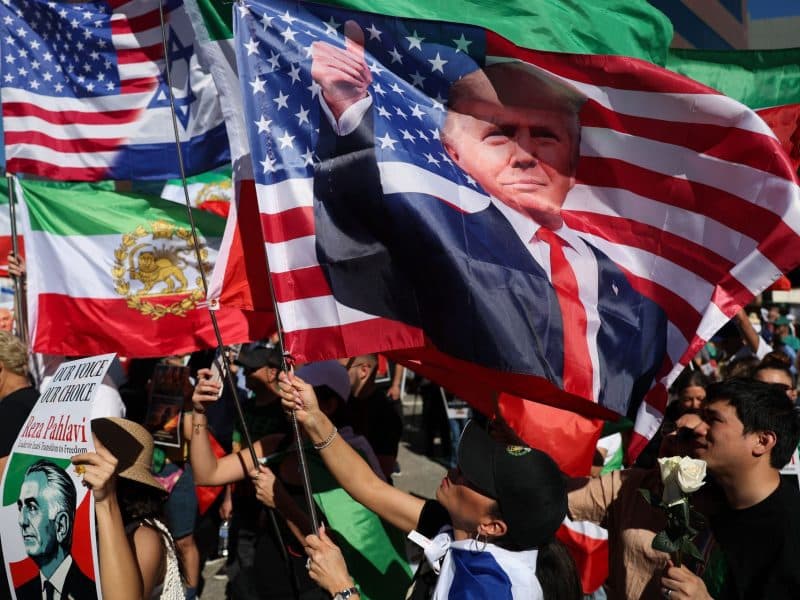
Despite opposition from some of their peers, vocal figures in the Iranian diaspora have framed the protests as an alliance between patriotic Iranians seeking to revive the grandeur of Persian civilization and the government of Israel supporting them in a quest against Tehran’s tyranny. In most demonstrations by expatriates in European cities and their strongholds in Canada and the United States, they have been carrying the flag of Israel along with the flag of the Iranian monarchy.
These oft-exaggerated statements have projected an image of an immigrant community that is reactionary and even racially prejudiced. In some videos circulating online, Persian exiles are criticized for lacking sympathy for the people of Palestine as they endure a humanitarian tragedy. Anti-Muslim and anti-Arab sentiments have also been vocalized more explicitly at times by social media influencers belonging to this ideological collective.
The supporters of Iran’s deposed royal family, which has claimed leadership of this round of protests, have been ardent in their support for Israel, painting Prime Minister Benjamin Netanyahu and his government as benign forces who have the best interests of Iranians at heart. Netanyahu is wanted by the International Criminal Court, and, if arrested, is expected to stand trial in The Hague for the commission of war crimes and crimes against humanity in Gaza.
Azam Ali is a noted Iranian musician based in Los Angeles and a 2007 Hollywood Music Awards recipient. She has been outspoken in her advocacy for democracy and human rights in Iran. She has also been left distraught by the dehumanization of othered communities by right-wing Iranian exiles. She is similarly skeptical of inauthentic allegiances being marketed as the will of 90 million Iranians.
“Any new establishment seen as empowered by U.S. or Israeli military backing, especially after the catastrophe in Gaza, would lack legitimacy for a population as diverse and historically conscious as Iran’s,” she told New Lines. “For Iranians, foreign intervention is not an abstract fear but a lived memory.”
“As someone who has been an outspoken critic of Israel’s occupation and genocide, I know how appeals to Israeli or U.S. power now resonate across Iran and the Global South — they are politically toxic and morally discrediting,” she added.
In a bid to paint itself as being aligned with the preferences of Donald Trump and win his support for some form of military action against Iran, the diasporic opposition has found it useful to reiterate the talking points of the White House on the Middle East and immigration, among other issues. This means old eugenicist tropes about Iranians belonging to a superior Aryan race are also being curiously invoked these days.
Ali, who is the co-founder of the musical duo Niyaz, and has collaborated with renowned composers such as Ramin Djawadi, Brian Tyler and Peter Murphy, has drawn on her social media reach to warn against homegrown movements in Iran being appropriated for geopolitical agendas abroad. And like other critical observers, she believes the infighting of the Iranian diaspora is not helping those homegrown demands.
“Exile, trauma and long-term detachment have led parts of the opposition to overestimate their influence while losing touch with the rhythms and constraints of life inside Iran. Exile inevitably distorts perspective,” she said.
“When political work is reduced to online outrage, factional warfare and engagement metrics, it substitutes performance for strategy. A movement that presents itself as divided and punitive cannot function as a unifying force.”
On the streets of Rasht, like other major cities, events unfurled at a puzzling pace and then fizzled out unexpectedly, as if nothing had happened. It’s only a trail of death and destruction that’s left behind, debris and rubble stacked up in some of the most frequented neighborhoods, and bereaved families that may never find an answer to the loss of their loved ones.
I managed to talk to Erfan, a content producer whose creative internet access solutions could sporadically bypass the internet shutdown.
“I personally knew a couple of people who were in the protests, and they were killed. Someone was not even protesting, but he was a bystander hanging around a pharmacy. Two people emerged out of nowhere, shot multiple bullets, and they were dead,” the 25-year-old told me from Rasht on Jan. 12.
“One of the families set up a small memorial and published a banner, showing the person’s portrait. They took down the portrait,” he said. “I was at the memorial service the other day and noticed the presence of security forces. It was so intimidating people couldn’t even mourn freely.”
In the absence of reliable reporting inside the country and amid a climate of fear, one way the tragic events of Iran are being memorialized is through protest art by international artists as well as Iranians living overseas. These creative acts of solidarity have portrayed the plight of Iranian people — often lost in the bombast of political commentary and oratory by insincere politicians — in more accessible forms.
Mehrdad Aref-Adib is an Iranian-born illustrator and visual artist based in London, whose work often depicts themes inspired by Iranian culture, as well as moments of national uprising like the events that followed the morality police killing of Mahsa Amini in 2022. He believes artistic expression is an important way of preserving the legacy of protest movements.
“Protest art advances movements by sustaining attention, memory and emotional endurance. Its influence accumulates over time. Protest art rarely ends a struggle, but it often ensures that it is not erased,” he told New Lines. “The most ethical work does not claim closeness to suffering. It refuses indifference without turning pain into spectacle.”
Many artists and public intellectuals believe in the same principle, that proximity is not the best measure of solidarity. In response to the displays of resilience and bravery by the people of Iran protesting peacefully and defying security forces, household names in literature, the arts and entertainment have voiced their support for Iranians.
Academy Award-winning actress Juliette Binoche, Turkish novelist and President of the Royal Society of Literature Elif Shafak, legendary singer-songwriter Madonna, American educator and YouTuber Ms. Rachel, and iconic Irish singer Chris de Burgh are some of the names that have thrown their weight behind the people of Iran in their quest for freedom and dignity.
Dina Doosti is one of the members of the popular Iranian folklore music ensemble Rastak, which was founded in 1997. She left Iran in 2021 during the COVID-19 pandemic and as the blend of sociopolitical crises facing the nation made it increasingly difficult for her to continue working independently. She lives in Turkey now, where she remains a member of the famed band, whose performances have taken them to Australia, Belgium, Chile, Iraqi Kurdistan, Kazakhstan, Poland and Sweden.
“Although my friends and I at Rastak found it inevitable to move out to continue our artistic work, as arts couldn’t exist in a real sense anymore, Iran, despite all the problems it was dealing with, was still a habitable place,” she told New Lines. “But after the COVID pandemic and especially following the Mahsa Amini movement, the country went in a direction that wasn’t sustainable, and it wasn’t only the economic pressure on people that was building up, but people were bearing the burden of mounting psychological pressure, too.”
Doosti, a musician who plays a traditional Iranian bowed string instrument known as Kamancheh, said she has not been able to work over the past several days as the news and footage emerging from Iran have been too troubling to give her the chance to concentrate. Still, she’s committed to using her artistic medium to recreate the voices of Iranians, even if instrumental music doesn’t carry words, she said.
“I think people are living in conditions that are unbearable, and they believe it can’t get worse, so they are fighting with their utmost power to bring down a regime that has, for so many years, taken our identity away from us. So I don’t think it would be afraid to take people’s lives,” she told me. “It will do anything it takes to remain in power.”
Although artists have tangible products to offer at times of collective grief and anguish, statements of support by politicians don’t necessarily come across as truthful, especially if their policymaking clearly contradicts their words. In recent weeks, members of Congress, former and current U.S. politicians, and almost all major European leaders have reaffirmed that they stand with the Iranian people.
There is little indication that this rhetoric of support has been matched with verifiable action. Trump’s blanket travel ban on Iran is still in place, and the restrictions on Iranians were even compounded further at the height of the protests. On Jan. 14, the Department of State included Iran in a list of 75 countries from which immigrant visa applications won’t be processed due to “public charge” concerns.
In a tweet, the State Department singled out Iran, alongside Somalia, Haiti and Eritrea, as one of the countries whose citizens have “abused” the “generosity of the American people.” An earlier presidential proclamation from December had suspended the processing of naturalization for permanent residents from Iran, including those with approved U.S. citizenship applications.
Restrictive immigration policies against Iranians are not a staple of the Trump administration. For years, European Union countries have adopted hard-line policies in screening visa applications from Iran, and even the most permissive countries have enacted new constraints, even if extrajudicially.
In 2025, after the Italian embassy in Tehran activated its visa appointment system for a total of only eight days in the whole year, it took a court in Turin to order the Italian Foreign Ministry to rectify what the judge described as “discriminatory behavior” in response to a lawsuit by Iranian students. The students were represented by the civil rights group the Association for Juridical Studies on Immigration, which drew national attention to what it called an “absurd situation.”
This isn’t an isolated case. Germany’s embassy in Tehran has not been offering regular consular services for months, and Britain’s mission is more or less the same. Limitations on Iranian immigrants’ banking and financial rights, international mobility and access to employment opportunities, as well as their experiences with discrimination in education, are familiar stories that have not been reversed with declarations of support like the tweets from politicians flooding social media these past weeks.
Senior figures of the opposition in exile, including former Crown Prince Reza Pahlavi, have not highlighted these concerns. Pahlavi has also not reacted to the rare deal between the Islamic Republic of Iran and the Trump administration on the deportation of Iranian nationals. Two flights taking off from U.S. airports have so far returned 175 people to Iran as part of an agreement for the deportation of nearly 400 Iranians.
Although Pahlavi has constantly talked about his commitment to prosperity for Iranians, asserting that his legitimacy stems from their calls for his action, he has also failed to denounce Israel’s military campaign against Iran last summer. In the middle of talks between Tehran and Washington, Israel launched surprise attacks on Iran, killing 1,062 Iranians, including 45 children.
Not only did the royal not question Israel’s militarism, but the social media activists and pressure groups affiliated with him also vehemently abused those who disagreed with the war, accusing everyone of being apologists for the Iranian government. Social media aggression and trolling from this camp continues, now targeting those who oppose the U.S. and Israeli intervention in Iran in response to the protests.
On Jan. 12, CBS News’ Norah O’Donnell asked Pahlavi in an interview if he believed he had to accept a share of responsibility for the civilian casualties, effectively sending people to their deaths by encouraging them to take to the streets as they expected a crackdown. “This is a war, and war has casualties,” he said.
Five days later, my phone buzzed with an Instagram message notification. I had texted a journalist friend in Tehran to ask how the situation was. It seemed that connection was restored momentarily. Signals were back just long enough for her to send a one-line note: “It’s very bad,” followed by four crying face emojis.
Related Articles
Tehrangeles Syndrome
For a long time, the Iranian diaspora has projected itself as a far-right, firebrand community, one that is only a shadow of the entrepreneurial immigrants from Iran and their offspring who have made it in America. The expats’ embrace of war on their home country and their indifference to ICE crackdowns on their neighbors have been unfathomable to observers
Between Iran and Me
If Iranian arts and culture have been glaringly missing from our newspaper pages and TV screens for so long, if Iran resurfaces to the headlines and everyone has heard something about it without knowing anything about its provenance as a civilization, and if Iran’s civil society continues to be discounted, it is the outcome of a collective failure.
US-Israeli Strikes Damage UNESCO Heritage Site in Iran
A US-Israeli airstrike substantially damaged the Golestan Palace, a 15th century royal complex in Tehran and the former residence of the Qajar Dynasty. Since the start of the war, an increasing number of iconic locations, neighborhoods, parks, and local businesses have been bombed. Donald Trump had floated the idea of targeting Iran’s cultural sites in his first presidency.